As I work on the map of Granite Falls, Minnesota in the Progressive Era, I am narrowing in on the medallions for the map. The Andrew J. Volstead House is an must have medallion, but selecting the best face of the house led me down a rabbit hole that turned into a video. The Library of Congress has historic Sanborn Fire Insurance maps that illustrate the changing footprint of the house from 1893 to 1949. Photo credits to the Granite Falls HIstorical Society and for the oldest photos of the house, the Yellow Medicine County Historical Society.
This project is led by the Granite Falls Historical Society and funded by a grant from the Southwest Minnesota Arts Council. I will be creating two maps: one of Granite Falls in the Progressive Era (1890-1920) focusing on Andrew J. Volstead and his family and another of Lac qui Parle and Fort Renville (1840s). So honored to be working on this project.
The Victorian home at 1122 Raymond Avenue with its asymmetrical shoulder slopes didn’t catch my attention at first, since the Victorians decorated with towers and turrets across the street feature more prominently in information about the area. The story of one of its first residents, however, illustrates a Black community rallying to support civil rights laws.
1122 Raymond Avenue, Saint Paul MN
This house was built in 1885. The Saint Paul City Directories of the time list William Augustus Hazel and his wife Rosa at this address from 1896 to 1899. They had been living on the east coast where William had apprenticed as a stained glass artist and as an architect. The couple moved to Saint Paul around 1890 so William could represent the Tiffany Glass Company in Minneapolis (See 1890 article in the Appeal). The couple lived on the east side and Rondo before settling at 1122 Raymond for the last half of the decade, before William went on to academia, notably establishing the school of architecture at Howard University.
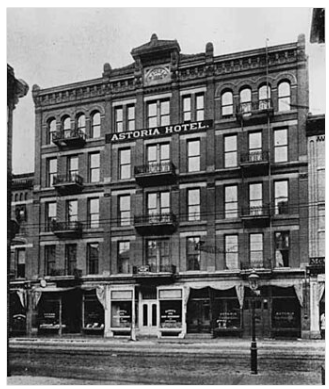
William’s introduction to Saint Paul was not full of welcome. An 1887 article in the Appeal describes how he was refused accommodations at the Clarendon Hotel (corner of Wabasha and 6th) and Astoria Hotel (374 Wabasha) due to the color of his skin.
William sued the hotels for $2,000 and won the high profiled lawsuit for $25 and community recognition for taking a stand.
While his impact on civil rights in Minnesota and work in academia live on, I was unable to find any of his creative work. Local work included the now demolished St. Peter’s AME Church (downtown St. Paul, Minnesota) created in 1888 and the 1895 stained glass windows in the demolished Austin Catholic Church, Austin, Minnesota.
William Augustus Hazel The Montgomery Advertiser, Sun, Oct 17, 1993 ·Page 91
August in Park Point is green and full of raspberries and jewel weed. A completely different world from the snow-dune blanketed peninsula of my last visit in April. This time I followed the map from my most recent drawing of Park Point to the location called Peabody’s Landing to confirm what I suspected from the research completed at my kitchen table earlier. The narrow sidewalk that runs from the trail to the shore of the Superior Harbor is a remnant of Peabody’s Landing, named for the ferry service run by Charlotte and John Harry Peabody, who lived on the Point.
In 1853, George Stuntz, deputy U.S. surveyor, established a trading post, warehouse, dock and transfer company at the Landing. He ferried people and goods between Wisconsin and the Point and was granted exclusive rights of usage by the Territorial Legislature for a period of fifteen years. Stuntz traded with the Anishinaabe people for whom the Point was still a seasonal home and sacred site of their burial grounds. The 1854 Treaty of La Point established the Fond du Lac reservation and while the treaty was to maintain the Anishinaabe’s rights to hunt and fish freely outside the reservation, treaties were broken.
As early as the 1850s, vacationers made the short trip across the harbor to Park Point. By 1900s, the Peabody’s were ferrying the wealthy citizens of Duluth and Superior across the harbor to summer cabins built on federally-owned land. Superior’s Mayor Charles O’Hehir kept a cabin there from 1900-1927, and that Pine Knot Cabin was the last cabin on the site, razed in 2010.
The first European settlement along the Duluth Superior Harbor was Fort Saint Louis, a trading post of the North West Company. The fort was located at the present day intersection of 2nd and Winter Streets in Superior, WI, near the depot from which Thirsty Pagan Brewing operates. The North West Company was first organized in 1779 in Montreal and dominated the North American fur trade west of the Rocky Mountains in the early 1880s. Their agent Jean-Baptiste Perrault oversaw construction of the fort in 1793 and John Sayer managed it during its peak years. By 1805, the fort employed 109 people and its stockaded walls contained 2 one-gun blockhouses, two 40′ long houses and 60′ warehouse and shed. After the War of 1812, control of the area shifted from British Canada to the United States. The Fort of Saint Louis ceased business in 1916 at which time the American Trading Company established Fond Du Lac Fort up river on the Duluth side.
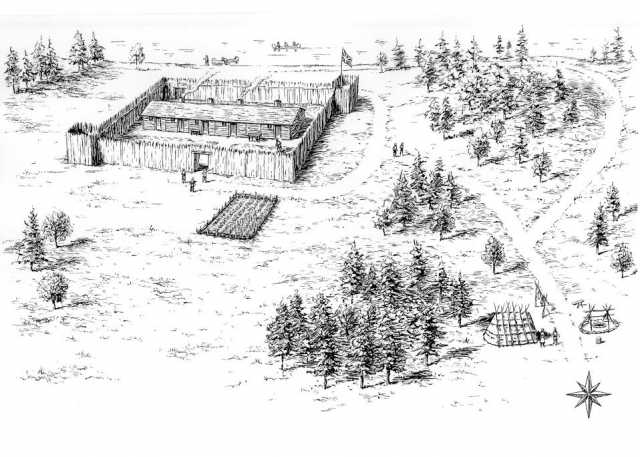
Images of Fort Saint Louis were difficult to find, however the Minnesota Historical Society maintains another North West Company trading post at Ginebig-Ziibi (Snake River) https://www.mnhs.org/furpost built near the same time and also managed by Sayer. This museum and David Geister’s drawing below served as inspiration for the depiction of Fort Saint Louis on my Park Point drawing.
George Bonga captured my imagination as I read about the history of Fort Saint Louis. He was born in 1802 to Pierre Bonga (a Black fur trader working from Fort Saint Louis) and Ogibwayquay (an Ojibwe woman). George Bonga worked in northern Minnesota as a fur trader and translator, speaking English, French, and Ojibwe. He went to school in Montreal. He returned to the Duluth area and frequently guided white travelers and traders through the region. He worked as an advocate for the Ojibwe in their dealings with trading companies and the United States government. His full story is worth the read here https://www.mnopedia.org/person/bonga-george-ca-1802-1874.
When you walk along the Park Point trail, at a certain point you see enormous hulking dark ore docks across the Superior Bay. The ore docks are no longer in use as of 1970, but they still have a profound presence in Superior and Allouez bays.
Darla the Dog in her element at Park Point, 4/16/2019
Also known as the Burlington Northern Ore Docks, these docks were the largest in the world and consisted of three structures of concrete and steel. The were used from 1890 to 1970. The longest dock was 2244 feet long, 80 feet high, and contained 374 individual pockets which can hold 100,000 long tons of ore or 7 average trains of 205 cars each. Over one billion tons of ore were shipped through these docks, the largest year’s shipment being 32.3 million tons in 1953. (https://www.hmdb.org/m.asp?m=147249)
Working conditions were hard on the docks. In 1913, workers walked off the job after two ore punchers were crushed to death. Ore punchers climbed on top of the train cars hauling ore and broke up frozen ore with poles so the ore could be loaded on to ships. The men who died in 1913 were killed when the trains began to move without any notice to the workers.
Frank Little (1879-1917) represented the Industrial Workers of the World. He was involved in organizing lumberjacks, metal miners, migrant farm workers, and oil field workers into industrial unions, often as part of free speech campaigns. He arrived in Duluth in August to support the strike of the ore-dock workers against the Great Northern Railway over dangerous working conditions. In the course of the strike he was kidnapped and held at gunpoint outside of the city, until he was rescued by union supporters.
Frank Little’s story is compelling but short. I recommend this video of Jane Little Botkin giving a talk to the Montana Historical Society about her research and her book Frank Little and the IWW.





 KIIHN ART MAPS