The first European settlement along the Duluth Superior Harbor was Fort Saint Louis, a trading post of the North West Company. The fort was located at the present day intersection of 2nd and Winter Streets in Superior, WI, near the depot from which Thirsty Pagan Brewing operates. The North West Company was first organized in 1779 in Montreal and dominated the North American fur trade west of the Rocky Mountains in the early 1880s. Their agent Jean-Baptiste Perrault oversaw construction of the fort in 1793 and John Sayer managed it during its peak years. By 1805, the fort employed 109 people and its stockaded walls contained 2 one-gun blockhouses, two 40′ long houses and 60′ warehouse and shed. After the War of 1812, control of the area shifted from British Canada to the United States. The Fort of Saint Louis ceased business in 1916 at which time the American Trading Company established Fond Du Lac Fort up river on the Duluth side.
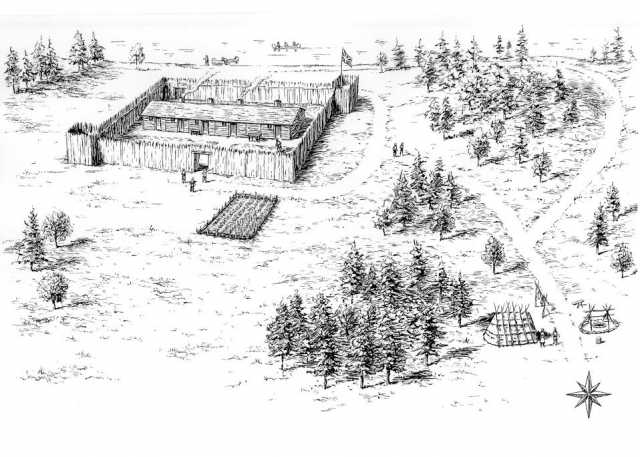
Images of Fort Saint Louis were difficult to find, however the Minnesota Historical Society maintains another North West Company trading post at Ginebig-Ziibi (Snake River) https://www.mnhs.org/furpost built near the same time and also managed by Sayer. This museum and David Geister’s drawing below served as inspiration for the depiction of Fort Saint Louis on my Park Point drawing.
George Bonga captured my imagination as I read about the history of Fort Saint Louis. He was born in 1802 to Pierre Bonga (a Black fur trader working from Fort Saint Louis) and Ogibwayquay (an Ojibwe woman). George Bonga worked in northern Minnesota as a fur trader and translator, speaking English, French, and Ojibwe. He went to school in Montreal. He returned to the Duluth area and frequently guided white travelers and traders through the region. He worked as an advocate for the Ojibwe in their dealings with trading companies and the United States government. His full story is worth the read here https://www.mnopedia.org/person/bonga-george-ca-1802-1874.

 KIIHN ART MAPS