“Catherine – Totidutawin (1791-1897) Prominent member of the Dakota Medicine Lodge, advanced standing among her people, converted to Christianity in 1837. She helped build and support the church, raised her children under her new faith.”
– paraphrased from The Peace Seekers: The Indian Christians and the Dakota Conflict by Dr. Elden Lawrence
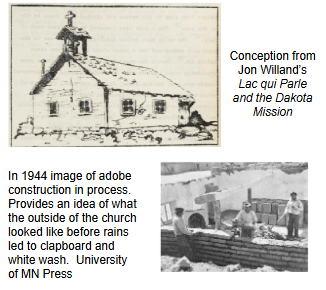
In the map drawing of Lac qui Parle, Catherine is depicted in the foreground with a trowel signifying her work building the first church in the mission at Lac qui Parle. Behind her is that first church, built by adobe brick but later covered in clapboard and white wash to better weather the elements. The young man is Lorenzo Lawrence her son. Behind the church are the bluffs around Lac qui Parle.
Dr. Elden Lawrence writes about his great grandfather Lorenzo Lawrence and great great grandmother Catherine in his book The Peace Seekers: The Indian Christians and the Dakota Conflict:
“Totedutawin was one of the two wives of Chatka. She was a Wahpeton Dakota born in 1791. She was a prominent member of the Dakota Medicine Lodge or the Dakota Sacred Dance Society. Though women were regarded in a lower esteem than men, she was of advanced standing among her people in traditional rituals and customs. She gave up these practices to become a disciple of Christ, and in August of 1837 she asked Joseph Renville to burn her medicine bag. She was baptized in December of 1837, took the Christian name of Catherine and decided she would end her polygamous relationship with Chatka and live with the missionaries. Her son, Lorenzo, and his siblings had the unique opportunity to be raised with the loving guidance of a Christian monther and a chance to learn a new faith.
For fifty-one years, Catherine was a devoted Christian with an admirable ability and skill to produce crafts that she used to raise money to help build and support the church. But it was her commitment to her new beliefs that established her as a true disciple of Christ. Because she had renounced her traditional Dakota beliefs, she became subjected to many persecutions, such as the destroying of her goods, and the cutting up of her blanket and other belongings, as was the punishments for violating Dakota religous rules. In more severe situations, Dakota Christian livestock were killed, haystacks burned and even homes destroyed. To honor the Sabbath as the Lord’s Day, Catherine refused to travel to another campsite on Sundays. She would wait and catch up the next day.
“In the aftermath of the Dakota War, the government annulled all treaties with the Dakota, and exiled all the Dakota from the State of Minnesota. Catherine was among the innocent refugees taken and held in a concentration camp at Fort Snelling for the winter of 1862-63. Over three hundred Dakota died in the six months they were held at Fort Snelling. The Dakota refugees were then exiled to Crow Creek in Dakota Territory where they suffered another three hundred deaths from exposure, starvation and disease.“
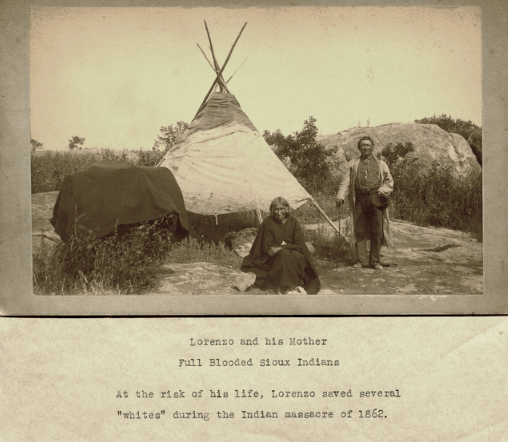
Dr. Elden Lawrence discovered this image of Catherine and Lorenzo. This image is now part of the collection at the Minnesota Historical Society. In my portrait of Catherine, I used images of the Lawrence family to portray her at the age she would have been when building the church.
The first church at Lac qui Parle was finished in 1842. A year later, the brick was covered in clapboard to prevent weather erosion. The congregation worshiped there until 1853–54, when many members moved downriver to the newly established Upper Sioux Reservation. The missionaries went with them, closing the station at Lac qui Parle and establishing new stations alongside the Dakota congregations at Hazlewood and Pejutazizi.
In Mary and I: Forty Years with the Sioux, Stephen Return Riggs quoted Catherine Tutidutawin writings: “Now are we to have a church, and on that account we rejoice greatly. In this house we shall pray to the Great Spirit. We have dug ground two days already. We have worked having the Great Spirit in our thoughts. When we have this house we shall be glad… In this we will pray for the nations.”

