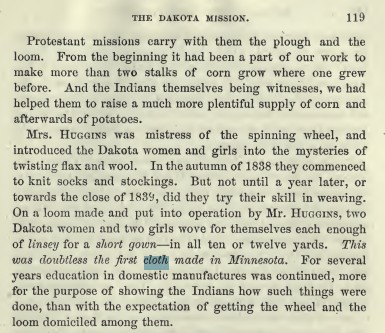
“First cloth woven in Minnesota: in 1839, Missionaries made a loom. Two Dakota women and two girls wove themselves each enough linsey for a short gown – 10 or 12 yards.”
–Paraphrased from The Dakota Mission by Stephen Return Riggs
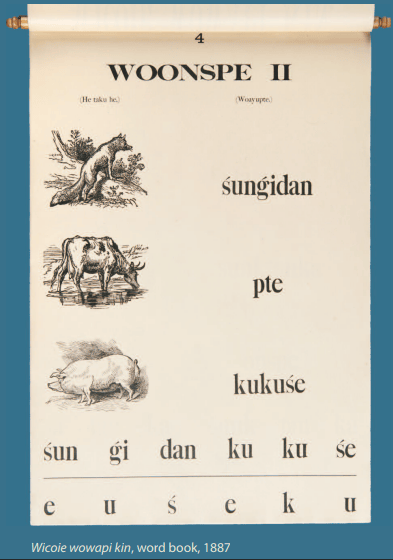
In the map drawing of Lac qui Parle, a Dakota woman works at a loom with a missionary providing instruction. The room is the interior of the mission church that also served as the mission school. On the wall is are primers for learning the written Dakota language.
A couple sources identify this Lac qui Parle first:
-and-
FIRST WOOL MANUFACTURED IN MINNESOTA.
The first manufacture of wool in Minnesota was at the Presbyterian mission at Lac qui Parle. The wife of A.G. Huggins, an assistant missionary taught the Sioux girls to twist flax and wool, and in the fall of 1838 to knit socks. The next year Mr. Huggins put up a loom, and two Sioux women and two girls, each, wove enough linsey to make a gown.
-History of the Minnesota River Valley, Including Explorers and Pioneers of Minnesota by Rev. Edward D. Neill and History of the Sioux Massacre by Charles S. Bryant. North Star Publishing, Minneapolis 1882.
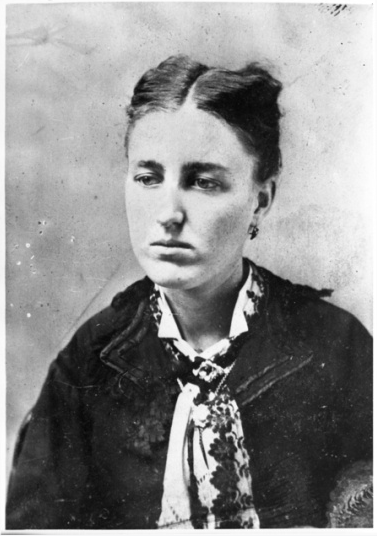
The missionary women played active roles. Lydia Pettijohn Huggins (1812–1890) led farming work with her husband and ran the mission school.
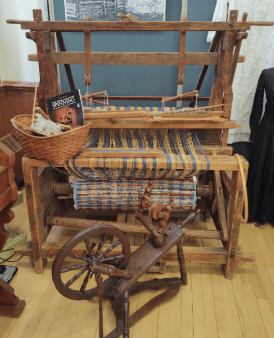
Teaching the Dakota women how to weave was part of the missionaries efforts to give knowledge that may help Dakota people survive with the changes that were coming. In order to determine what the loom looked like, I researched handcrafted barn and floor looms that Alexander Huggins would have been familiar with. A good example of this type of loom is at the Bloomington Historical Society.
Among the missionaries other work included creating a written version of the Dakota language. The mission’s publication work in Dakota included reading and spelling books, hymns, portions of the Bible, a Dakota newspaper, dictionaries, and the Constitution of the State of Minnesota. Below is from a word book.