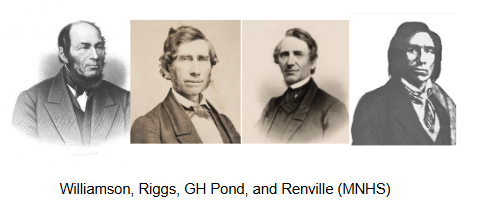
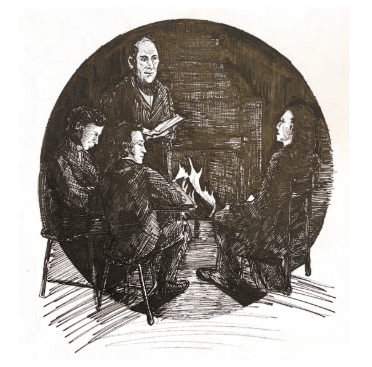
“Preserving the Dakota Language: Dr. Thomas Williamson would read a verse from the French bible. Joseph Renville would repeat it in Dakota. Gideon Pond and Stephen Riggs wrote down the Dakota words.”
-Paraphrased from the Mary and I: Forty Years with the Sioux by Stephen Return Riggs
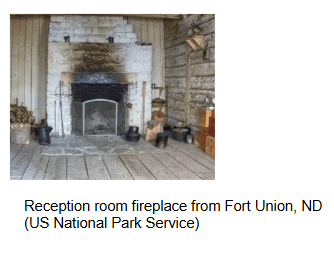
In the map drawing of Lac qui Parle, the missionaries of the American Board of Commissioners of Foreign Missions work with the Dakota fur trader and all around Renaissance man Joseph Renville to translate the Bible into the Dakota language. Behind them is the fireplace of Fort Renville’s reception room.
In the early 1800s, the lake called Mde Iaúdaŋ (Small Lake that Speaks) was in the heart of Waȟpéthuŋwaŋ Dakota homeland. In 1826, Joseph Renville established a trading post at the lake and became an influential leader there. Joseph Renville invited the missionary families of Dr. Thomas Williamson and Alexander Huggins to establish a mission and school at Lac qui Parle. The missionaries depended on Renville and his family for protection and influence among the local Waȟpéthuŋwaŋ. Throughout the 1830s, the mission community grew. The families of Stephen Riggs and Samuel and Gideon Pond arrived. The misson became a place of family life where the children of missionaries and Dakota children grew up together. https://www.mnhs.org/mnopedia/search/index/structure/lac-qui-parle-mission
Through the Lac qui Parle mission, Renville worked to further strengthen relationships among the European and Dakota peoples. With missionaries Thomas S. Williamson, Stephen R. Riggs, and Samuel and Gideon Pond, he translated the Bible and various hymnals into the Dakota language. Dakota is an oral language, and Renville’s translations were among the first attempts to record Dakota in written form. https://www.mnhs.org/usdakotawar/stories/history/joseph-renville
Stephen Return Riggs’ Mary and I: Forty Years with the Sioux describes Mr. Renville, who sat in a chair in the middle of his own reception room, in which there was at one end an open fireplace with a large blazing fire, and Dr. Williamson, Mr. G. H. Pond, and myself, seated at a side-table with our writing materials before us. When all were ready, Dr. Williamson read a verse from the French Bible. This, Mr. Renville, usually with great readiness, repeated in the Dakota language. That winter, the Gospel of Mark was finished.